
Quiche near me: what’s actually in ours on Broad Street
Searching “quiche near me” around Milford? Here’s what’s actually in ours, why it sells out, and how to get a slice at BetterWorld on Broad Street.
Type “quiche near me” into your phone in Milford and you’ll get a handful of results. Here’s what you’ll actually find if you walk into BetterWorld: quiche baked in-house, in small batches, sold from the case next to the espresso bar. Last week it outsold the croissants. It’s not a secret menu item. It’s just not the first thing people think to ask for.
We run two most days: a sausage quiche and a roasted-vegetable one. Both come from the same case that holds the muffins and the sourdough, so if you’re timing a visit around lunch, don’t leave it too late — a small batch means a small batch.
What’s actually in it
This isn’t a chain-restaurant quiche reheated from frozen. It’s eggs, a filling that changes with what’s good that week, and a proper crust — baked here, that morning, not shipped in. The roasted version leans on whatever vegetables are worth using that week. The sausage one is a straightforward, filling version for people who want something heartier before a hike.
Here’s the honest part: a classic quiche starts with a butter crust, and butter crust means wheat flour. We’re known around here as a gluten-free bakehouse, and a lot of what’s in that case is genuinely GF — but the quiche isn’t one of them. If you’re baking gluten-free at home every week, ask before you order. We’d rather tell you upfront than have you find out at the table.
Why it sells out
We don’t do a printed, fixed menu, on purpose. The board changes with what’s fresh and what the season’s giving us, which means some days you’ll find three kinds of quiche and other days none at all. That’s a genuine tradeoff. If you need certainty, call ahead. If you’re the type who likes finding out what’s on the counter that day, you’ll probably like how we run things more than you expect to.
Quiche also isn’t something you can bake fast to meet a lunch rush. It goes in early, it comes out whenever it’s actually done, and once a batch is gone, the next one isn’t ten minutes away. That’s the cost of not freezing and reheating everything. We think it’s worth it. Your mileage may vary if you’re in a hurry.
A better lunch than the deli case
A slice of quiche with a side salad costs more than a sandwich from a gas station deli counter. We won’t pretend otherwise. What you’re paying for is a filling made that morning by someone who works here, not a case of pre-made trays trucked in weekly. For a sit-down lunch on Broad Street, or something to grab before a walk along the Delaware or up toward Milford Beach, it holds up better than most grab-and-go food does after twenty minutes in a bag.
It also travels well if you’re heading out of town — cold quiche is a perfectly reasonable car snack on the drive back from a Poconos weekend, in a way a hot sandwich just isn’t.
Pair it with something from the espresso bar
Most people order quiche with a coffee, which makes sense — it’s rich enough that a straight black coffee or a cortado balances it out better than something sweet. If you haven’t figured out your usual order yet, our espresso bar guide walks through the basics. The short version: if you like your coffee strong and small, start there; if you want something with more milk, say so and we’ll build it.
What we’re heading into this fall
September on Broad Street means fewer day-trippers than August and more regulars settling back into a routine. Quiche does well this time of year — it’s warmer weather food that also works once the mornings turn cool, which September in Pike County reliably does by the third week. It’s not a seasonal special. It’s just a good fit for right now.
How to get a slice
BetterWorld is at 320-322 Broad Street, Milford, PA 18337, open 8am to 6pm every day. Call 570-832-8555 if you want to check what’s in the case before you drive over — worth doing on a weekend, when quiche is one of the first things to go. If it’s gone when you arrive, the sourdough and the sandwich board are both solid backups, and we’ll have quiche again the next baking day.
Vitamin store near me: what’s actually on the shelves in Milford
Searching “vitamin store near me” in Milford, PA? What’s actually on the BetterWorld shelves, what we’ll talk you out of, and why we’re not the cheapest.
Every September the same thing happens. School goes back, the first cold night hits Pike County, and people start walking into the store asking what they should be taking.
If you’ve searched “vitamin store near me” from somewhere around Milford, you’ve probably found the chains out on the highway and then found us on Broad Street. We’re different in ways that matter and in ways that don’t. Here’s the honest version before you drive in.
What a vitamin store near me looks like at 322 Broad
Smaller than you’re expecting. That’s the first thing.
The supplement section is a set of shelves, not a warehouse aisle. We carry a few hundred items rather than a few thousand, and they’re chosen rather than stocked. Basics that most people actually use: vitamin D, magnesium, a decent B complex, fish oil, zinc. Probiotics in the cooler, because the live ones belong in a cooler and a lot of shops don’t bother.
Then the seasonal end of it. Elderberry in every form it comes in. Echinacea. Throat things. That shelf gets rearranged around now and emptied out by February.
Herbs and teas sit next to it, loose and bagged. There’s a bath and body run - soaps, salves, the sort of things people buy for someone else in December.
We will talk you out of things
This is the part that surprises people.
Walk in and ask what you should take and the first answer is usually “probably less than you think.” A shelf of capsules doesn’t replace eating properly, sleeping, and getting outside, and anyone who tells you otherwise is selling. Most people do fine on two or three things, not twelve.
We also won’t tell you a supplement will cure anything. Not allowed to, and wouldn’t want to. What we can do is tell you what’s in a bottle, what the sourcing looks like, and why one magnesium costs eleven dollars and the one beside it costs twenty-six.
If you’re on prescription medication, ask your doctor or your pharmacist before you add anything. Interactions are real and a retail counter isn’t the place to sort them out.
The tradeoff, said plainly
We’re not the cheapest. Amazon will beat us on a lot of items and so will the big-box places on Route 6.
What you get instead is somebody who can hand you the bottle and answer a question about it, stock that hasn’t been sitting in a third-party warehouse of unknown provenance, and the option of buying one thing today rather than a jar of four hundred. For some people that’s worth the difference. For others it isn’t, and that’s a fair call to make.
The one place we usually do win on price is bulk. Herbs, teas and a good number of pantry staples are cheaper by weight from the bulk bins than the same thing packaged, and you’re not paying for a container you’ll throw out.
What else is in the building
Most people who come in for vitamins leave with something else, because the supplement shelves sit inside a store that’s also a cafe, a bakehouse, a bookshop and a grocery.
The cafe is at the front. Organic espresso, and the pastry case, which does a lot of the heavy lifting in the mornings. The health store side runs from produce through pantry through the supplement shelves. There’s a wall of books on growing food and keeping animals that has nothing to do with vitamins and everything to do with why the store exists.
It’s an easy stop to combine with a walk. Milford Beach and the McDade Trail are both a few minutes out, and the light on the Delaware in late September is the reason people move here.
Come in and ask
You don’t need to know what you want before you arrive. Most people don’t, and the questions are the useful part.
BetterWorld, 322 Broad Street, Milford, PA 18337. Call 570-832-8555. Open 8am to 6pm, every day.
Mornings are quieter if you want time at the shelves. Saturday around eleven is the busiest hour of the week - good for the cafe, less good for a conversation about magnesium.
BetterWorld sells food and supplements. Nothing here is medical advice, and no product mentioned is intended to diagnose, treat, cure or prevent any disease. Talk to your doctor before starting a supplement, especially alongside prescription medication.
Hot Chocolate Near Me: What’s in Our Award-Winning Cup
Most hot chocolate is cocoa powder stirred into hot water or milk from a packet — fine for what it is, but not what you’re getting here. Ours starts with Goodnow Farms House Blend Hot Cocoa, steamed into organic milk rather than mixed with water, and the difference shows up in the first sip.
The chocolate
We use Goodnow Farms House Blend, from a small-batch, bean-to-bar chocolate maker that has picked up multiple International Chocolate Awards for its drinking chocolate. This particular blend has been recognized as one of the best hot chocolates in the country. It’s the same chocolate we use in our mochas, so if you’ve had one of those and liked it, you already know the base.
Why it tastes different
We steam it into organic milk instead of building it on hot water, which is what makes it richer and creamier than what you’ll get at most cafés. It’s also lightly sweetened and leans dark — closer to a European drinking chocolate than the very sweet, cocoa-and-sugar mix most Americans grew up on.
That means if you’re used to Swiss Miss or chocolate syrup stirred into milk, ours will read as less sweet on the first try. That’s by design, but it’s easy to adjust: ask for a pump of simple syrup, or one of our organic flavors — vanilla, caramel, or butterscotch — and we’ll sweeten it to match what you’re used to.
Ordering for a kid
Let us know if it’s for a child and we’ll make it at a cooler, kid-safe temperature. No need to spend ten minutes blowing on it before they can drink it — just ask when you order and we’ll take care of it.
Iced, frozen, and the Australian-style version
If you want it cold, we’ve got three ways to go: an iced chocolate, a frozen hot chocolate (a blended iced chocolate frappe), and an ice-cream-based chocolate milk. That last one is worth calling out by name, because it’s what you’d actually get if you ordered an “iced chocolate” in Australia — a chilled version of our hot chocolate, poured over ice-cream instead of ice. If that’s what you’re picturing, ask for “chocolate floatte” and we’ll start getting excited for you.
Smoothies in Milford, PA: what’s actually in them
If you’ve searched “smoothie near me” in Milford and landed here, here’s the short answer: yes, we’re open, and no, we don’t use a powder base. Every smoothie at BetterWorld2 starts with real fruit and oat milk we make ourselves, that morning, in-house. Not from a carton.
That last part is the whole story, honestly. Most juice bars buy oat milk by the case because it’s faster. We make it fresh because it tastes better and nothing’s added to stretch the shelf life — no gums, no stabilizers, no seed oils hiding in an ingredient list nobody reads. The tradeoff is real: on a busy Saturday morning, that can mean a few extra minutes at the counter while a fresh batch runs out. We think it’s worth the wait. Not everyone will agree, and that’s fair.
What’s in the Tastes Like Snickers
The name does the marketing for us, but here’s what’s actually in it: banana, peanut butter, cacao, maca, mesquite, date, and cacao nibs, blended into our house oat milk. No candy, no added sugar syrup — the sweetness comes from the banana and the date. It’s one of the most-ordered smoothies on the menu, and if you want to make it a meal instead of a snack, add protein powder for $2. Our staff’s pick for where protein powder actually improves the flavor: Banana Honey, and this one.
If peanut butter and chocolate isn’t your thing, the menu runs wider than that. Green Vanilla (banana, mango, baby spinach, vanilla) is the one we point people toward if they say they “don’t really like green smoothies” — the mango carries it. Mango “Salted Caramel” (mango, dates, mesquite, lucama, vanilla, maple, pink salt) is the one that surprises people. And Berry Choc-Chip (blueberries, acai, banana, mango, raspberries, cacao nibs) is the closest thing on the smoothie side to our acai bowl.
The PB Power Bowl
Bowls are a different category from smoothies here — thicker, spooned not sipped, and topped rather than blended smooth. We wrote about our Acai Bowl a couple weeks ago (acai, blueberries, mango, banana, raspberries and mint, topped with fresh fruit, gluten-free granola, toasted coconut and cacao nibs), and it’s still the one most people ask for by name.
The PB Power Bowl is the one that’s crept up the order count since. It’s built the same blended-fruit way but with pumpkin seed protein, then finished with peanut butter mixed through rather than added as an afterthought — so it eats more like a proper breakfast than a dessert. If you’ve had our Acai Bowl and added peanut butter on top, this is the version of that idea, done properly.
Fresh juices, if you want something lighter
Not everyone wants a full smoothie in the morning. The fresh juice side of the menu is smaller and simpler: Pine For You (pineapple, apple, mint, lime), Zinger (apple, lemon, strawberries), Hardcore Veg (carrot, cucumber, celery, beet), and a few others that rotate with what’s ripe. Nothing here is cold-pressed and shipped in from somewhere else — it’s juiced to order, same counter, as you watch.
What people are saying
“They make the best smoothies! So flavorful with very fresh fruit, great on a hot day. Like its sister store two doors down, this is a good place for small gifts like handmade soaps and herbal teas (including gifts for yourself!) and has a welcoming, peaceful atmosphere and a very kind staff. It’s an enjoyable third place to hang out, and a great place to learn about and acquire trustworthy organic herbs. Highly recommend!” — Mary Silver, Google review
Where to find us
BetterWorld2 is at 320 Broad Street in Milford, right next door to the main BetterWorld store — open daily, 9am to 5pm. If you’re coming from the café side, walk out the front door and you’ll see us within a few steps.
Sandwiches near me: lunch on Broad Street in Milford
If you’re searching “sandwiches near me” from a car on Route 6, you probably want three things: somewhere close, somewhere quick, and somewhere the bread isn’t sad. Milford is small enough that the first two are easy and the third one narrows it fast. We make sandwiches at Better World on Broad Street, on fresh croissants, and lunch is one of the busiest hours of our day. Here’s what to expect, when to come, and who should ask questions before ordering.
The croissant is the whole argument
A sandwich is mostly bread. That’s not a criticism — it’s just arithmetic.
Most places serving lunch buy their bread in. It arrives sliced, in a bag, and it’s been engineered to survive a truck. It does its job and you forget it immediately. That’s not us.
We use French croissants that come out of our oven that morning instead. That difference alone leaves your typical sandwich in the dust. But add to that a more gourmet selection of meats, preserves and salad, and you’ve just upscaled your lunch experience ten-fold.
The trade-off is that we don’t make sandwiches to order. We make a select range and when we sell out, we sell out.
If you want a custom sandwich or bagel – Broad Street still has several more options for you.
What’s on the board
The board changes. We’re not going to publish a fixed menu here and have you drive over for something that ran out on Thursday.
What’s consistent: there’s always a sandwich option, there’s usually quiche — the sausage and the roasted vegetable both sell steadily — sometimes sausage rolls and cheesy tarts and there’s soup once the weather turns, which around Pike County is roughly late September.
What’s seasonal: the sandwich fillings follow what’s actually good right now. Some of our more frequently available combos include: Turkey, brie & cherry; Chicken, caramelized onion & gruyere; Salami & provolone with pepperoncini; Roast Beef with sun-dried tomatoes & lemon garlic aoli; and a smokey egg salad.
Call ahead if you’re driving in specifically. 570-832-8555 and someone will tell you what came out this morning.
If you eat gluten-free, ask first
Plenty of people see our GF pastry sign in the window, make their way to the pastry case, see the sandwiches and hope we’ve achieved the impossible: GF croissants. We haven’t. Maybe one day.
Our croissants are wheat. If you’re coeliac, these sandwiches are not for you. Sorry.
What we do have, clearly labelled, is a proper gluten-free range — the seasonal quiches, pot pies and the parfaits among them. Ask what’s gluten-free today and you’ll find a bounty of options.
When to come, and when not to
Noon to one is our tightest hour. If you can come at 11 or 11:30, you’ll wait less and there’ll be more left on the board.
Saturdays are busy from mid-morning. Not just for lunch — the lunch pastries clear out early, and the espresso bar has a queue most of the day through summer, but don’t let it turn you away — we move incredibly quickly.
The quiet stretch nobody uses is mid-afternoon on a weekday. Take a sandwich to the bench outside, or drive five minutes to Milford Beach on the Delaware and eat it there. Milford Beach and the boat access points are a short run from Broad Street and September is the best month of the year for that.
We’re open 8am to 6pm, every day.
Making it a real lunch
Two things worth adding while you’re at the counter.
A cold brew, if it’s still warm out. It’s the only coffee that hasn’t dropped off as summer wound down — everything else is starting its slow shift back toward hot drinks, and cold brew keeps selling regardless.
And something from the health store side for later. Or a jar of local honey, a good cheese, something for the pantry. Most people come in for one thing and leave with four, which is either a feature or a warning depending on your budget.
Finding us
BetterWorld is at 320-322 Broad Street, Milford PA 18337, in the middle of town with plenty of free street parking.
Open 8am to 6pm daily. Call 570-832-8555 to check what’s on the lunch board before you drive.
If you’re new to town, walk in and ask what’s good today.
How to Order Your Perfect Coffee at an Espresso Bar
Walk up to the counter at most espresso bars and the menu reads like a foreign language: cortado, flat white, macchiato, Americano. Most people default to whatever they ordered last time, or just say “a coffee” and hope for the best. Here’s what’s actually in each of those cups — and two things almost everyone gets wrong.
Every espresso drink starts the same way
Underneath the different names, every drink on the menu (except drip coffee) starts with the same thing: a shot of espresso. What changes from drink to drink is simply how much hot water or steamed milk gets added on top, and in what ratio.
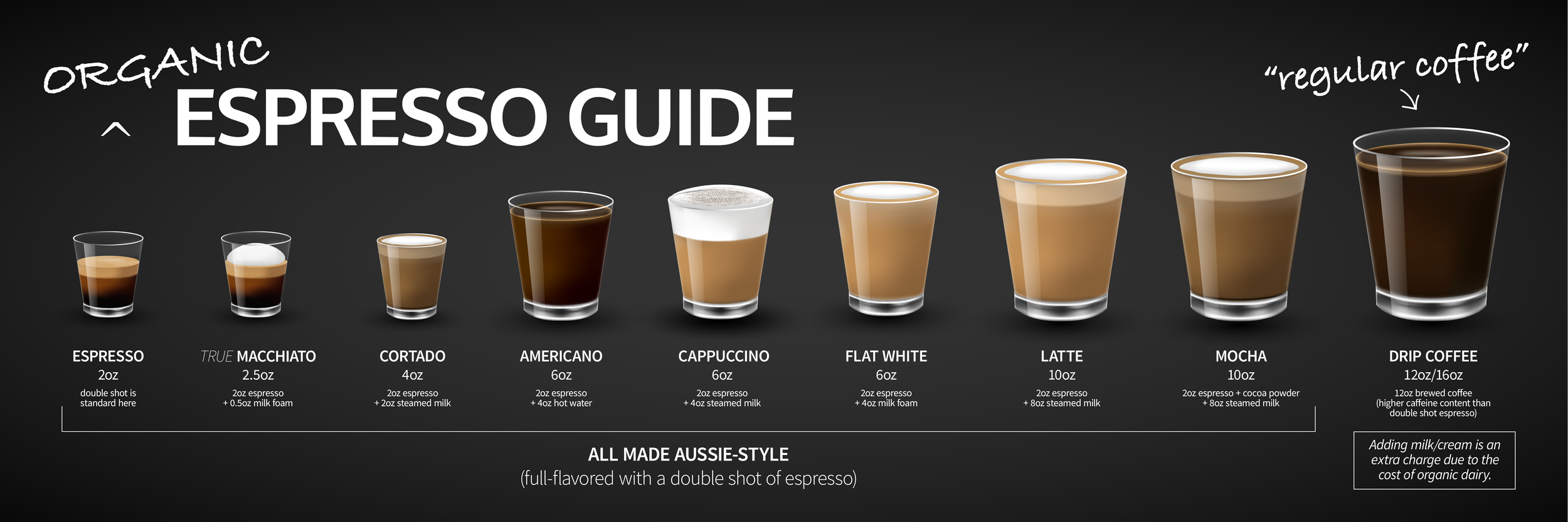
Here’s how it breaks down, made Aussie-style — full-flavored, with a double shot of espresso as the standard rather than the single shot you’d get at a lot of American shops:
Espresso — 2oz. Just the shot. A double is standard here.
True Macchiato — 2.5oz. 2oz espresso “marked” with 0.5oz of milk foam. Not to be confused with the caramel-drizzle version some chains call a macchiato — this is the original.
Cortado — 4oz. 2oz espresso cut with 2oz steamed milk. Equal parts, no foam to speak of.
Americano — 6oz. 2oz espresso with 4oz hot water. This is not drip coffee — more on that below.
Cappuccino — 6oz. 2oz espresso, 4oz steamed milk, with a thick cap of foam.
Flat White — 6oz. 2oz espresso with 4oz milk foam, microfoam rather than cappuccino’s thicker cap — smoother, silkier texture.
Latte — 10oz. 2oz espresso with 8oz steamed milk. Smooth, mild and milk-forward.
Mocha — 10oz. 2oz espresso, cocoa powder, and 8oz steamed milk.
Drip Coffee — 12oz/16oz. Brewed coffee, no espresso involved at all.
Myth #1: an Americano is just drip coffee
This is the mix-up we hear the most. An Americano is espresso — two shots, cut with hot water. Drip coffee is brewed a completely different way, with hot water passed slowly through grounds. They can end up looking similar in the cup, and both are lighter than a straight shot of espresso, but the process and the flavor are not the same drink at all. If you like the strength and roast character of espresso but want something you can sip over a longer stretch, an Americano is what you’re after — not a request to “make the drip coffee a little stronger.”
Myth #2: espresso has more caffeine than a regular cup of coffee
Ounce for ounce, espresso is far more concentrated — roughly 40mg of caffeine per ounce, versus about 10mg per ounce for drip. That’s exactly why this myth exists: a shot tastes and hits stronger, and it’s gone in a few seconds instead of sipped over twenty minutes, so it feels like more caffeine.
But a shot of espresso is only 1–2oz. A cup of drip coffee is 12–16oz. Multiply it out and the larger serving wins: a standard cup of drip coffee generally contains more total caffeine than a double shot of espresso. So an Americano or a straight double shot will hit you fast and hard, but if you’re chasing the highest total caffeine count, the drip coffee — or a latte or Americano made with an extra shot — is usually the better bet.
A note on milk
We steam organic dairy, and organic milk costs more than conventional — so drinks that use it (cappuccino, flat white, latte, mocha) run a bit higher than a straight espresso or Americano. It’s not a markup for the sake of it; it’s the actual cost difference of sourcing organic milk.
Make it yours
Any drink on the menu can be built with organic flavor add-ins — you’re not locked into the base recipe. If you want your cortado with a splash of organic vanilla or your mocha with organic caramel, just ask. The size and ratio stay the same; you’re just customizing the flavor on top.
The short version
Next time you’re at the counter, think in two questions: how much espresso do you want to taste (a straight shot tastes strongest, a latte the mildest), and how do you want it cut — hot water, steamed milk, or foam. Answer those two and you’ll land on the right drink every time, whether that’s a cortado, a flat white, or a couple of shots of espresso over ice.
If in doubt, you can rarely go wrong with a latte or mocha.
And if you’re after “regular coffee” don’t order an americano. Order a drip coffee instead.
Stop in and try one — we’re happy to walk you through the menu in person if you’d rather just point at what sounds good.
Sourdough bread near me: the loaf, the starter and the book
Bread was our fourth-biggest seller last week. Not coffee, not cake. Bread.
If you’ve been searching “sourdough bread near me” from Milford or anywhere in the Poconos, you can walk into 322 Broad Street and buy a loaf today. But that’s only a third of what we keep. We also sell the starter culture to make your own, and the books that teach you how. Which is a slightly unusual thing for a shop to do, and the reason is worth explaining.
What’s actually on the shelf
Two families of sourdough, and they’re not interchangeable.
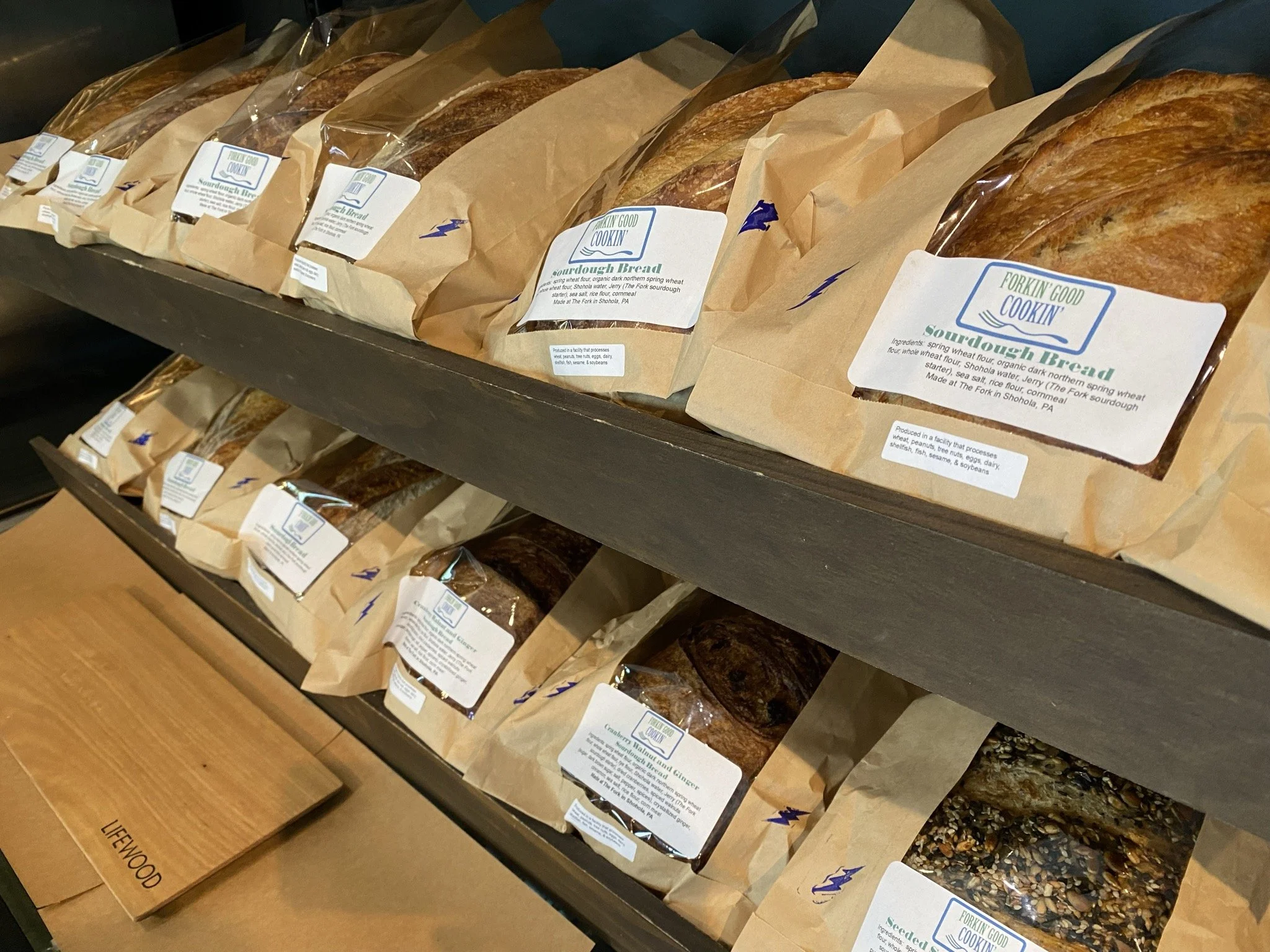
The wheat sourdough is the one most people come in for. Real long-fermented sourdough, sold by the loaf from the bakehouse counter. High-hydration loaves, made the slow way.
Eight wheat versions are available: original, organic, rye, whole wheat, olive & za’atar, cranberry & walnut, seeded multigrain, garlic & asiago, and cheddar & jalapeño. The seeded is the one staff fight over. $8.99 for most. $9.99 for organic and rye.
The gluten-free sourdough is a different animal entirely. The starter is water and brown rice flour, and the loaves are built on sorghum, millet and cassava flour with psyllium husk holding them together. Made especially to have a crust, which is rare in a gluten-free bread. A 26oz loaf, $11.99, two weeks in the fridge, six months frozen, and it comes in compostable packaging.
When do we have it?
Almost every day. Peter from Forkin Good Cookin’ in Shohola bakes loaves fresh each morning by 11am and delivers to us every day except Tuesday and Thursday. He does bake more for us on Mondays and Wednesdays to make up for his days off though. And yes, they’re still fresh the next day (if they don’t sell out) and will last you the week.
Monday: Original and organic
Wednesday: Gluten-Free, Original and assorted flavors above (call a few days ahead if you’d like a specific flavor)
Friday: Original, organic and rye
Saturday: Original and assorted flavors above (call a few days ahead if you’d like a specific flavor)
Sunday: Original and organic
The honest bit about gluten
Long fermentation breaks down some gluten. You’ll read that a lot, usually with the implication that sourdough is therefore fine for people who react to wheat.
It isn’t. Not if you have coeliac disease.
Wheat sourdough is still wheat. The fermentation makes it easier on plenty of people with a mild sensitivity, and that’s a genuine difference. But it does not make it safe if gluten is a medical problem for you. If that’s you, the gluten-free loaves in the fridge are what you want, and they’re a properly separate product, not found on the shelf with the other sourdoughs.
Why we sell the starter as well as the loaf
Here’s the part that makes us a strange bakery.
Sitting on the shelf a few feet from the bread is a shelf-stable gluten-free sourdough starter, cultured with organic brown rice flour, $18.99. There’s a Breadtopia starter jar, straight-walled glass with a lid that keeps contaminants out but lets air in, and a rubber o-ring so you can mark where your starter sat before its last feed, for $12. And in the bookstore section, Emilie Raffa’s Artisan Sourdough Made Simple and Elaine Boddy’s Easy Everyday Sourdough Bread.
Buy those three and you never need to buy a loaf from us again.
That’s deliberate. The self-sufficiency side of this shop exists because Liam’s view, argued at length in his own book, is that knowing how to make the thing matters more than being able to buy it. Selling you the skill undercuts selling you the product. We do it anyway.
Sourdough in a Pike County kitchen
Practical note for anyone starting a culture here: our houses are cold from October, and a sluggish starter in a Milford kitchen in January is almost always a temperature problem, not a flour problem. Find the warmest spot you have. On top of the fridge works. So does an oven with just the light on.
Late August is a good moment to begin. The kitchen’s still warm enough to get a starter established in four or five days, and by the time the first properly cold weekend hits you’ll have something stable to feed.
One warning: the loaves sell out regularly - sometimes within the hour. They’re baked in limited numbers. If you’re driving in from Honesdale or Port Jervis specifically for one, ring ahead.
Come in and have a look
Bread, coffee, and a wall of books about growing and making your own food, all in the same building.
The BetterWorld Store is at 320-322 Broad Street, Milford PA 18337, open 8am to 6pm every day. Call 570-832-8555 to check what came out of the bakehouse this morning, or just come in. The loaves are near the counter and someone will tell you honestly which one to take home.
Homesteading supplies in Milford: what you need after canning season
Looking for homesteading supplies near Milford, PA? What to buy after canning season: fermenting, seed saving, dry storage, and the books worth owning.
Late August is when the panic sets in. The garden is producing faster than anyone can eat, the jars you bought in July are already full, and there’s another crate of cucumbers on the porch. If you’ve been searching for homesteading supplies without wanting to drive to Scranton or wait four days for a box, we’re on Broad Street.
Canning gets all the attention this time of year, and we’ve already written about that. But canning is one tool. Most of what saves a harvest in Pike County happens with no heat at all.
Fermenting is the easy win nobody starts with
If you have too many cucumbers, cabbages or green beans right now, ferment them.
It’s cheaper than canning. There’s no boiling water bath, no pressure gauge, no two hours over a hot stove in a kitchen that’s already 85 degrees. You need salt, water, some pickling spices, a jar and something to keep the vegetables under the brine. That’s the whole list.
The gear is genuinely simple. Glass weights to hold everything down. An airlock lid so you don’t have to burp the jar every day. Good salt without anti-caking agents. That’s what people come in for and it’s what we keep on the shelf.
The honest caveat: your first batch might be mush. Ferments are sensitive to temperature, and a hot upstairs kitchen in August moves fast. Start with one jar, not six. Keep it somewhere cool and dark. A basement in an old Milford house is close to perfect.
Seed saving is the step most people skip
Buying seed every spring is fine. Saving your own is better, and this is the fortnight to do it.
Let a few of your best plants go past eating. Beans dry on the vine. Let a lettuce bolt. Pick tomatoes from the plant that did well in your soil, not the one from the catalogue photo. Then you need somewhere dry to keep it all until March, which is where most attempts fall over.
Come in and ask about seed and dry-storage gear: envelopes, jars, labels, the boring things that decide whether next year’s planting works. And if you’d rather start from bought seed for next season, ask what we’ve got in. Stock shifts with the calendar.
One warning worth giving. Saved seed from hybrid plants often won’t come back true, so you can do everything right and still get a strange result. Save from open-pollinated varieties if you want it to be reliable.
Dry storage: the part that quietly matters most
You can grow and preserve beautifully and still lose half of it to mice, damp or light.
Pike County houses are old, basements are cool but often damp, and mice treat a paper sack of oats as an invitation. What actually holds up is glass and metal with a real seal, kept dark, kept cool, and labelled with a date you’ll believe in February.
This is also where buying in bulk starts to make sense. Grains, beans, oats, flour, salt. Buy the quantity, store it properly, and you stop paying supermarket prices per pound. We sell most of that by weight, so bring your own container if you’d rather not take another bag home.
The books are half the point
The bookstore side of BetterWorld exists because self-sufficiency is a skill, not a shopping list.
You can’t buy your way into knowing when a ferment has gone wrong, or how deep to plant garlic in this climate zone, or what to do with a glut of quince. That comes from a book you can put on the bench with flour on your hands, or from somebody who’s already made the mistake.
We keep the practical end of that shelf stocked: preserving, growing, keeping animals, mending, building. If you’re after a specific title, ask. And if you want the argument for why any of this matters, Liam wrote a whole book about it, which you’re welcome to pick up and disagree with.
What we won’t pretend
You don’t need most of the gear the internet sells you.
A lot of homesteading kit is a solution to a problem you don’t have yet. Buy one thing, use it until it’s second nature, then buy the next. The people who last at this are the ones who started with a jar of sauerkraut, not a dehydrator, a pressure canner and a grain mill bought in the same week.
We’d rather sell you one jar and see you again in October than sell you a cupboard full of equipment you feel guilty about.
Come in and ask
We’re at 320-322 Broad Street, Milford, PA 18337, open 8am to 6pm every day. Call 570-832-8555 if you want to check on something specific before you drive in.
Bring your problem, not a list. Tell us what’s overflowing in your kitchen this week and we’ll tell you the cheapest way to deal with it. Then have a coffee while you think about it. The espresso bar is in the same building.
Visiting BetterWorld & BetterWorld2 in Milford: your questions answered
We get asked the same handful of questions most days at the counter, so here they are in one place. If yours isn’t below, call us on 570-832-8555 or just ask when you’re in — we like the company.
What’s the difference between BetterWorld and BetterWorld2?
One building, two storefronts. BetterWorld at 320-322 Broad Street is the café, gluten-free bakehouse and bookstore — coffee, pastries, and shelves of classic titles and practical solutions to global challenges. BetterWorld2, right next door at 320 Broad Street, is the juice bar, health food store. apothecary and refillery — smoothies, acai bowls, wellness shots, and zero-waste refills. Different registers. Same mission, same family, same phone number.
What are your hours?
Café & Bookstore: 8am–6pm, every day. Juice Bar & Health Store: 9am–5pm, every day. We’re open all week, including weekends. Milford doesn’t take a day off, and neither do we.
Where do I park?
Broad Street has free street parking right out front, and along the side roads, plus a public lot a short walk behind the shops. Parking is never a drama, even during leaf-peeping season.
Is the bakery actually safe if I have celiac disease?
Yes. Our bakehouse is dedicated gluten-free — we don’t bake with wheat on site, which matters if you’ve been burned before by a “gluten-free menu” cooked in a kitchen that also handles flour. Still tell us about any other allergies when you order. We can’t promise every ingredient on the shelf is nut-free or dairy-free.
Can I bring my kids?
Always. We stock traditional wooden toys and screen-free games so kids have something to do while you drink your coffee. Every table doubles as a spot for a board game or a deck of conversation cards.
Is there somewhere to sit, or is it grab-and-go?
Both. There’s seating if you want to stay and work, and the coffee travels fine if you don’t. Weekday mornings are quieter for a laptop. Weekends get busy enough that you’re better off enjoying the buzz than fighting it for a table.
Do you take cards, or is it cash only?
Cards, Apple Pay, and cash — whatever’s easiest for you. No minimum spend.
Do you sell gift cards?
Yes, in store or by calling 570-832-8555. One card works across both BetterWorld and BetterWorld2, so it covers coffee, groceries, juice, books and gifts in a single swipe.
Do you sell any of this online?
Not yet. Everything here is built to be experienced in person — the smell of the bakehouse, the weight of a wooden toy in your hand, the first sip of a cold brew you didn’t make yourself. If you’re not local, the best we can offer is a good reason to visit Milford.
Come see us at 320-322 Broad Street, Milford, PA. Café open 8am–6pm; Juice Bar & Health Store 9am–5pm; seven days a week. Call 570-832-8555 with anything we haven’t covered here.
The Golden Bowl at BetterWorld2: Milford’s healthiest smoothie bowl
“THE GOLDEN BOWL IS MY FAVORITE!!!” — that’s a direct quote from a regular’s Google review, capital letters and all, and it’s the kind of unprompted enthusiasm you can’t manufacture with a menu description.
What’s in it
A turmeric-forward smoothie base — the “golden” in the name — blended thick enough to eat with a spoon, topped the way a proper smoothie bowl should be: fresh fruit, crunchy granola and golden flax seeds, something you’d actually want in every bite rather than just on top for the photo.
Why people order it more than once
Two things tend to happen with regulars: they find one bowl or juice they love and stick with it, or they cycle through the menu depending on the day. The Golden Bowl is squarely in the first camp — it’s the kind of order people stop thinking about and just repeat.
Alongside it, the Zinger juice gets the same loyalty from a different regular, and acai bowls get ordered two at a time by customers who “10/10 recommend” the whole experience, staff included.
The honest caveat
A turmeric smoothie bowl isn’t a light snack — it’s a real meal’s worth of fruit and toppings, and it’s priced and portioned that way. If you want something smaller, ask about the smoothie menu instead.
Come try it
We’re at 320 Broad St, Milford, inside the same building as BetterWorld’s café and store. Open daily.
Gluten-free shopping in Milford: what’s actually safe to buy
“As a person extremely allergic to wheat, I cannot express my gratitude for BetterWorld enough.” That’s a recent review from a regular customer, and it’s the kind of line that means more coming from someone with a real allergy than from a marketing department. If you’ve got a wheat allergy or celiac disease, you already know the difference between “gluten-free friendly” and a shop that actually gets it right.
What we stock
A dedicated gluten-free bakery section — not just a couple of items tucked in with everything else, but a real range: bread, baked goods, and pantry staples made without wheat, rye, or barley. Alongside that, the wider health food side of the store carries gluten-free spices, GF pantry staples, and snack items people actually enjoy.
The honest caveat
We’re a shop, not a certified gluten-free facility. We maintain a celiac-safe space, with separate utensils for GF items and well trained staff. We do also stock products with gluten in it though, so if you have celiac disease rather than a wheat sensitivity, cross-contact is a real question to ask us about specific products, not assume away. We’d rather you ask at the counter than guess so we can keep you safe.
Why it matters more here than at a big chain
A small shop can actually know its own shelves. If you ask what’s safe, someone who stocked it that morning can usually tell you, rather than reading you the same allergen card every big retailer prints. That’s the whole advantage of shopping somewhere small for a dietary restriction — the person behind the counter usually knows more than the label.
Come see what’s in the pastry case
We’re at 320-322 Broad Street, open 8am to 6pm every day. The gluten-free bakery section is on the cafe side of the store.
No seed oils: what BetterWorld actually cooks with
If you’ve spent any time reading about seed oils lately, you’ve probably landed on Seed Oil Scout at some point — the site that maps out restaurants and products that skip canola, soybean, sunflower, safflower and the rest of the industrial seed oil lineup. We didn’t build our kitchen around a website. We built it before the conversation went mainstream. But it’s a useful place to send people who want the full case, because we’re not going to relitigate the biochemistry here — we’re just going to tell you what’s actually in our kitchen.
No canola. No soybean oil. No vegetable oil blends. Nothing that requires an industrial solvent to extract.
What we use instead
Butter, olive oil, and avocado oil, depending on what we’re baking. Nothing exotic, nothing that needs explaining on a menu. The honest tradeoff is cost — these all cost more than a jug of canola. We’ve made peace with that in order to feel good about what you end up eating.
The caveat we’ll give you straight
The science on seed oils is not as damning as the passion to avoid them may suggest. The prevailing understanding is that a general health decline and increased inflammation in the western world correlates with the introduction of seed oils into our diets, but so does a lack of sunlight and increased sugar and processed food consumption. We genuinely don’t know what the long term effect of seed oils is on the body, empirically. But at BetterWorld, we take a cautious approach and never want to take a risk on anyone’s health, so if we don’t know its good for you, we don’t want it.
That said, cutting seed oils out of your own kitchen at home is a bigger ask than swapping which café you visit. If you’re eating out elsewhere in town, or buying packaged food anywhere, seed oils are very likely in it — that’s the whole reason a site like Seed Oil Scout exists. We’re one café getting it right on our own menu. We’re not pretending that solves the wider problem.
And we’ll say plainly: we’re not doctors, and we’re not going to tell you seed oils are making you sick. What we can tell you is what’s in our kitchen, and let you make up your own mind about why that matters to you.
Why we bothered
Partly to avoid GMO ingredients. Partly to deliver greater nutrition. Partly because it’s consistent with everything else on the shelf — we’ve never been the kind of place that stocks the cheapest version of anything if a more honest version exists. The gluten-free options, the organic coffee, the wooden toys instead of plastic — it’s the same instinct, applied to what leaves the kitchen.
Come taste the difference
We’re at 320-322 Broad Street, open 8am to 6pm every day.
Traditional toys in Milford: why we stock wood, not plastic
Ask most gift shops why they sell wooden toys instead of the plastic, batteries-included kind, and you’ll get some version of “kids need to unplug.” True enough. It’s not our real reason.
Liam has spent the last few years writing a book about ending modern slavery — the supply chains behind the cheapest version of almost everything, including toys. A huge share of the world’s plastic toys are made fast, made cheap, and made possible by labor conditions nobody would accept if they saw them. That’s not a marketing angle. It’s the actual argument of the book, and it’s why the toy shelf at BetterWorld looks the way it does.
We can’t personally audit every wooden toy’s supply chain either — we’re not going to pretend otherwise. But smaller-batch, wood-based, built-to-last goods are structurally harder to make under exploitative conditions than a $4 plastic toy stamped out by the millions. Slower production, higher per-unit cost, and a maker who can’t hide behind ten layers of subcontracting. It’s not a guarantee. It’s a better bet.
What’s actually on the shelf
Right now that includes a wooden Viking shield — steel boss, knotwork carved into the face, sized for a kid who’s decided the back garden is a longship. No batteries, no app, nothing to charge overnight.
Alongside it: Elseware finger paint and beeswax crayons, both non-toxic and both made to be used with your hands rather than a screen. A copy of 1000 Hours Outside sits on the same shelf, which tells you what the whole corner is organized around — a case for less screen time, backed by the actual books making that case.
There’s a “Screen-Free Fun” section stocked with the kind of games and craft kits that don’t need charging: crystal-growing kits, card games, activity books. And on the reading side: The Daring Book for Girls and The Dangerous Book for Boys, the kind of thing a grandparent buys without needing it explained to them.
The honest caveat
A wooden toy costs more than the plastic equivalent, and it won’t do anything on its own — the kid has to bring the imagination. Some do. Some don’t, and for those kids, buy the thing they’ll actually play with. We’d rather say that than sell you a shelf ornament.
And we’re not claiming the whole shelf is independently audited back to the tree. What we can say is that we chose slower, smaller, wood over plastic — on purpose, for a reason that has nothing to do with nostalgia marketing.
As one recent review put it: “Toys I actually want my kids to play with… the ethos behind it all is fantastic.” That’s the shelf we’re going for.
Come and have a look
We’re at 320-322 Broad Street in downtown Milford, open 8am to 6pm every day. The toy corner is just past the register, in through the café side.
Raw honey near me: how to pick a jar that’s actually raw
Search “raw honey near me” and you’ll get a hundred jars that all say raw on the label. Most of them are lying, or at least stretching it. There’s no legal definition of raw honey in the United States. Anyone can print the word.
So the label won’t help you. What will is looking at the jar.
We stock honey at the Better World Store on Broad Street, and the fastest way to sort real from marketing is this: cloudy is good, crystallised is better, perfectly clear is a red flag. Clear golden honey that pours like syrup has almost always been heated and filtered hard enough to strip out the pollen, the wax bits and most of what made it interesting.
What raw honey actually means
Raw means the honey went from hive to jar without being heated past hive temperature and without fine filtration. That’s the whole idea. It keeps the pollen, the trace propolis, the enzymes and the aroma compounds that heat drives off.
Commercial honey gets heated for a practical reason. It pours better, it looks prettier on shelf and it resists crystallising. Nothing sinister. It’s just a different product, and you’re paying for shelf appeal rather than flavour.
Here’s the part people find annoying: raw honey crystallises. It’ll go grainy and pale in the jar, usually within a few months, and faster in a cold Pike County kitchen. That isn’t spoilage. Stand the jar in warm water for twenty minutes and it comes back. If your honey has sat clear and liquid for two years, ask yourself why.
The one on our shelf right now
We carry Beekeeper’s Daughter raw honey. The jar moving fastest at the moment is the 16oz Fall Blossom at $15.99, made from goldenrod, aster and purple loosestrife, harvested at the end of the season. It’s darker than the spring varieties and the flavour is noticeably stronger. Almost malty.
Some people hate it. If you grew up on clover honey in a plastic bear, fall blossom will taste like someone swapped your honey for something else entirely. Try it on a sharp cheese or in a marinade before you commit to a pound of it on toast.
We also carry Augusta Acres raw honey by the pint, though that one moves in and out of stock depending on what they’ve got. Worth calling ahead if that’s what you came in for.
What honey won’t do
Honey is food. Very good food. It isn’t medicine, and we’re not going to tell you a spoonful cures anything.
You’ll read that local raw honey handles seasonal allergies because it contains local pollen. It’s a nice theory and the evidence behind it is thin. The pollen that makes people miserable in Pike County in September is mostly wind-blown ragweed, and bees aren’t much interested in ragweed. If local honey helps you, we’re glad. Just don’t buy it as a treatment.
Don’t give honey to a baby under twelve months. That one is not a maybe.
Late summer is the right time to buy
Fall harvest lands from late August through September around here. That’s when the darker honeys show up. Goldenrod is everywhere along the Delaware Water Gap right now, and it’s the backbone of most Pennsylvania fall honey.
If you want a lighter, floral spring honey, you’re buying last season’s stock, and stock from small beekeepers runs out. The people who buy a year’s worth in one go tend to do it now.
One practical note: buy the size you’ll actually get through. A pound of honey in a two-person house lasts a long time, and while honey doesn’t spoil, an opened jar that’s been dipped into with buttery knives for eighteen months isn’t doing anyone any favours.
Come taste before you buy
We’d rather you tried a spoonful than took our word on which one you’ll like. The honey sits with the rest of the natural foods section, and someone behind the counter can tell you what’s just come in and what’s about to run out.
The Better World Store, 320-322 Broad St, Milford, PA 18337. Call 570-832-8555. Open 8am to 6pm, every day.
Gift shop near me: wooden toys, real books and things worth keeping in Milford
Searching “gift shop near me” in Milford, PA? Wooden toys, real books and useful things that last — here’s what’s actually on our shelves on Broad Street.
Search “gift shop near me” from anywhere near Milford and you’ll get the usual spread: candles, novelty mugs, a wall of things made to be given once and quietly rehomed within the year. We’ve all bought them. We’ve all received them.
We didn’t set out to be a gift shop. BetterWorld started as a café and a health food store, and the gifts crept in because we kept finding things we liked and couldn’t think of a reason not to stock them. Twenty-five people have mentioned gifts in our Google reviews without us ever asking them to, which tells us the shelves are doing something.
Here’s what’s actually on them.
Wooden toys and the traditional toy shelf
This is the corner people photograph.
There’s a wooden Viking shield in the shop right now — proper steel boss in the middle, knotwork hand-painted onto the face, sized for a seven-year-old who has decided the back garden is a longship. It’s not a licensed character. It doesn’t need batteries and it won’t be obsolete when the film comes out. A kid will either want it immediately or not at all, and the ones who want it tend to want it very badly.
That’s more or less our test for the whole toy shelf. Wood, not plastic. No screen, no app, no subscription. Something a child can drag through a field and hand down to a younger cousin in five years.
Traditional toys have had a strange revival and we’re not entirely sure the reasons people give are the real ones. Parents say “screen-free” and “non-toxic”, and both are true. But watch someone pick up a wooden toy in the shop and what they’re actually doing is remembering. It weighs something. It sounds right when you knock it on a table. Plastic makes a hollow click; wood makes a knock.
The honest caveat: a wooden toy costs more than the equivalent from a big-box store, and it will not do anything on its own. A child has to bring the imagination. Some kids don’t, and that’s fine – buy the thing they’ll actually play with. We’d rather tell you that than sell you a shelf ornament.
Books people keep
Books get mentioned in our reviews more than anything else in the shop except the staff. Thirty-five times, at last count.
The self-sufficiency and homesteading section is the heart of it – growing, preserving, keeping animals, fixing things. That’s the practical end. Then there’s nature writing that people buy for themselves and end up giving away, like Peter Wohlleben on how forests actually work, and the Cicely Mary Barker Flower Fairy books that grandparents pick up without a word and take straight to the register.
A book is the most reliable gift in the shop. It survives the sofa move. Nobody has ever had to pretend to like one.
The useful end of the shelf
Some of the best gifts here aren’t ornamental at all.
Raw wildflower honey from a local keeper. Plastic-free spring water in glass. Natural toothpaste, fragrance oils, good chocolate, the kind of small excellent thing you’d want in a hamper. Refillable containers for people who are trying to buy less packaging and can’t work out where to start.
We stock a lot of it because we use it. That’s not a marketing position, it’s just how a small shop gets stocked when nobody’s sending down a planogram from head office.
If you’re building a gift for someone rather than buying a single object, this is the section to raid. A jar of honey, a bar of chocolate, a good book, a bag of something from the bulk bins – assembled at the counter, it beats almost anything shrink-wrapped.
Why a small-town shop beats the search results
Here’s our stance, and it’s self-serving, so weigh it accordingly.
You cannot pick a gift properly online. You can’t feel the weight of the toy, you can’t read the first page, you can’t hold two things and know instantly which one is right for your sister. Every online gift purchase is a guess with a return label attached.
Twenty minutes in a shop on Broad Street solves a problem that two hours of scrolling doesn’t. That’s the whole argument.
What we can’t offer you is speed. We’re not going to have it on your doorstep tomorrow, and if you’ve left it until the night before, a big retailer will serve you better. We’re a shop for people who’ve got a few days.
Come and have a proper look
We’re at 320-322 Broad Street in downtown Milford, open 8am to 6pm every day. Come in through the café side, get a coffee from the espresso bar, and take your time with the shelves – nobody here will hurry you.
Questions before you drive over? Call 570-832-8555 and ask. If we haven’t got what you want, we’ll usually know who in town does.
The good you are doing by drinking here
There’s a quiet idea we keep coming back to at BetterWorld: that an ordinary cup of coffee is never really ordinary. Every cup is the end of a long chain — soil, farmers, roasters, milk, packaging, the town it’s poured in — and that chain either leaves the world a little better or a little worse. When you drink here, you’re pulling on the better end of it. This is what your cup actually does.
It starts on a farm that was treated well. Coffee is one of the most heavily sprayed crops in the world, and some of the chemicals used on it overseas are banned here at home. Every coffee we pull is organic — and so is the decaf, the tea, the milk, and even the flavors. That choice ripples backward down the chain: to soil kept alive with compost and shade rather than doused with synthetic pesticides, and to growers who are paid fairly for looking after their land and their people. Well-tended farms make better coffee, too. You can taste the difference, but the more important part is that your morning ritual isn’t adding to anyone’s toxic load — yours or a farmworker’s.
It keeps a real community running. When you buy here, the money largely stays here. It supports local jobs, small makers, and the artisans whose wood, pottery and preserves share our shelves. Compare that to the standard model, where the profit from your cup is routed to a corporate balance sheet far from the town that earned it. Same drink, completely different destination.
It makes less of a mess. The coffee industry’s default is the single-use cup — petroleum-lined, hard to recycle, and effectively permanent once it’s tossed. We work the other way: plant-based, compostable packaging, less plastic, and fewer disposables wherever we can manage it. One cup won’t save a landfill. A town’s worth of better choices, repeated daily, genuinely adds up.
It’s real food, not a masking act. A lot of chain coffee leans on sugar and additives to paper over cheap, bitter beans and commodity milk. We’d rather fix the cause than hide it: quality beans, organic whole milk, water filtered through six stages before it ever meets the espresso. When the ingredients are good, you don’t need to bury them.
And it’s building toward something bigger. What you see today is the start. Every purchase moves us toward the fuller vision — a farm-to-table café tied to a regenerative farm saved from development, a food forest where local kids learn to grow and cook, artisan goods made right here in town. Your cup is a small, daily vote for that future.
So here’s the honest pitch. You’re not just buying coffee. You’re choosing which chain of consequences you want to belong to — one that looks after the soil, the people who grow it, the town you’re standing in, and the world the next generation inherits. Drink to the world you want.
Things to do in Milford, PA: a local’s guide to the perfect day in town
Tucked into the corner where Pennsylvania meets New York and New Jersey, Milford is one of those small towns that punches far above its weight — historic streets, big forests, waterfalls, and some of the best food and browsing in the Poconos. Whether you’re up for the weekend or passing through the Delaware Water Gap, here’s how the locals would spend a day.
Start with the waterfalls. Raymondskill Falls, Pennsylvania’s tallest waterfall, is ten minutes from town in the Delaware Water Gap National Recreation Area, and the short trail to the viewing decks is manageable for most walkers. Closer still is Grey Towers, the grand French-château-style home of Gifford Pinchot, first chief of the US Forest Service — the grounds are free to wander and the view over the Delaware Valley earns every step.
Then give yourself the afternoon on Broad Street and Harford Street, the heart of Milford’s historic district. The town is compact, walkable and genuinely independent — independent shops, antique dealers, galleries and cafés run by people who live here. Stop by us at BetterWorld Store & Café at 320-322 Broad Street: organic espresso, a gluten-free bakehouse, a fresh juice bar, a self-sufficiency bookstore and shelves of made-in-America goods all under one roof. We’re open daily, no reservation needed, and the coffee is pulled with intention.
In summer, the Upper Delaware River is your playground: kayaking, tubing and swimming holes are all within twenty minutes.
If wellness is your thing, Milford has quietly become a destination for it. One block from us on Catharine Street, our sister venue Health House offers red light saunas, cold plunges, oxygen training, massage and natural facials — the perfect recovery stop after a morning of waterfall hiking.
Round out the day with a stroll to the Columns Museum, home of the famous Lincoln Flag, or catch a film or live show at the restored Milford Theater. Dinner at the Dimmick Inn, Bar Louis, The Delmonico Room, or grab a pizza from John’s of Arthur Avenue to eat at Barkley Park on Ann St. Or grab something to eat with a brew from the Log Tavern Brewery or Backroads Brewery on the outskirts of town.
Milford rewards the unhurried. Come for the falls, stay for the coffee — we’ll be here on Broad Street when you’re ready for a refill.
Refill store near me: how the refillery works at BetterWorld2, Milford
The first time someone uses a refillery they nearly always do the same thing: bring one bottle, refill it, and stand there for a second working out why that felt better than it should have.
It’s a small thing. You didn’t buy a new plastic bottle. That’s it. But the bin at home stays emptier and you stop paying for packaging you were throwing away anyway.
If you’ve searched “refill store near me” and come up short around the Poconos, we run a refillery at BetterWorld2 on Broad Street in Milford. Here’s how it works.
Bring a container. That’s the whole system.
Any clean container. Old shampoo bottle, jam jar, the pump bottle you liked from something you finished last month. We weigh it empty, you fill it, we charge you for what’s in it.
If you forget, and everyone forgets at least once, we can sort you out with something.
What you can fill varies, but the regular run of it is cleaning and laundry products, hand and body wash, shampoo and conditioner, and dry pantry goods. There are also bottles, jars and brushes if you’re building up a set of containers to keep using.
Why it’s cheaper, and where it isn’t
Buying by weight strips out the packaging cost, which on liquid household products is a real chunk of what you’re paying for. Refills on those are usually the clear saving.
Being straight about it though: not everything is cheaper than the cheapest supermarket own-brand. What you’re comparing is refills against decent-quality product, not against the very bottom of the shelf. On that comparison it holds up well. Against the absolute cheapest thing in a big-box store, sometimes it doesn’t.
The honest reason most of our regulars keep coming isn’t purely price. It’s that the bin stops filling up with bottles and the cupboard under the sink stops being chaos.
Starting without overhauling your whole house
The mistake is trying to switch everything in one go. You end up with a cupboard of half-used bottles and a vague sense of failure.
Better: pick the thing you get through fastest. For most households that’s hand soap, laundry liquid or washing-up liquid. Refill just that for a month. When the second refill feels automatic rather than an errand, add one more.
Six months of that and most of your regular consumables have quietly moved over. No dramatic conversion required.
What else is in the shop
The refillery sits inside our natural health store, so the same trip covers more than containers.
There’s the juice and smoothie bar: fresh juices, smoothies, acai bowls, protein bowls and wellness shots, all made to order. Which is a good thing to be holding while you decide what you’re refilling.
There’s the apothecary side: herbal remedies, homeopathic preparations, essential oils, natural pain relief and natural beauty products. Plus local honey, healthy snacks, beeswax candles and natural-fibre clothing.
It’s a small shop that does several things, which is either confusing or exactly what you want depending on the day.
Where we are and how we differ from next door
We’re at 320 Broad St, right beside the main Better World store at 322. Same family, different focus: 322 is the cafe, gluten-free bakehouse, food shop and bookstore. 320 is natural health, the juice bar and the refillery.
Worth knowing because the hours differ. We’re open 9am to 5pm every day. The cafe next door opens earlier and closes later.
Come and try one bottle
That’s genuinely the ask. Bring one empty container, refill it, see whether it feels like an errand or a relief.
BetterWorld2, 320 Broad St, Milford, PA, open daily 9am to 5pm. Call 570-832-8555 if you want to check we’ve got a particular refill in before you come down.
Canning supplies near me: putting up the harvest in Milford, PA
August is when it all arrives at once. The tomatoes come in faster than anyone can eat them, the peaches go from hard to overripe in about four days, and somebody at the farm stand tells you to take the whole box because they’ve got twelve more.
That’s the week people start searching “canning supplies near me” and discovering the hardware store has three lids and a shrug.
We keep this stuff on Broad Street in Milford, year round, because putting food up isn’t a hobby you can plan around shipping times.
What you actually need to start
Less than people think. Jars, new lids, a big pot, and something to lift hot jars out of water without burning yourself.
The thing nobody tells beginners: lids are the consumable. Rings and jars last years, lids don’t get reused for sealing. That’s the item you run out of mid-batch at 9pm with eleven pounds of tomatoes on the counter. Buy more than you think you need.
Beyond that it depends on what you’re preserving. High-acid things, tomatoes, most fruit, pickles, are water-bath territory and genuinely beginner-friendly. Low-acid things like green beans, corn and anything with meat need pressure canning, and that’s a different piece of equipment and a stricter set of rules. Don’t split the difference. Botulism is rare precisely because people follow the method.
Why buying locally matters for this specifically
Preserving is time-sensitive in a way most shopping isn’t. Fruit doesn’t wait two days for delivery. If you’re mid-batch and short on lids, you need them within the hour, not Thursday.
There’s also the picking-it-up-and-looking-at-it factor. Jar sizes, mouth widths, whether a lid fits the rings you already own at home, all easier to sort out standing in front of the shelf than squinting at a listing.
Milford sits well for this. Pike County has farm stands within a short drive, the Delaware Valley growing season runs long, and you can be back in your kitchen inside half an hour of realising you’re short.
The bulk side, which is the part people miss
Preserving is only half of a stocked pantry. The other half is dry goods, and we sell those by the scoop: grains, beans, flours, oats, rice, nuts, seeds, spices.
If you’re already filling jars with peaches, filling a few more with lentils and rolled oats costs almost nothing extra in effort. That’s how a pantry actually gets built. Not in one heroic weekend, but a few jars at a time across a whole season.
Bring your own containers if you have them. Empty jam jars work fine and it saves the packaging.
Books, because the method matters
We have a self-sufficiency bookstore, and this is the section where it earns itself.
Preserving is one of those skills where the internet gives you fifty conflicting answers and one of them will make you ill. A proper reference tells you processing times by altitude, which vegetables genuinely need pressure canning, and how to tell a good seal from a bad one. Worth owning in paper, because you’ll be reading it with wet hands and a phone that’s locked itself.
Ask us which one to start with. The right first book depends on whether you’re doing jams or working towards a full year’s pantry.
A realistic first weekend
Pick one thing. Tomatoes or peaches, whichever the farm stands are drowning in.
Do a small batch, six jars, not thirty. You’ll learn more from six and you won’t hate the process by the end. Something will go slightly wrong, one jar won’t seal, and you’ll eat that one this week. That’s the normal outcome, not a failure.
Then next weekend do it again, better and faster. That’s genuinely all there is to it.
Come and get set up
We’re at 320-322 Broad St, Milford, PA, in the middle of town. Jars, lids, bulk staples, and the books to make sense of it, plus coffee from the espresso bar while you work out what you’re doing.
Call 570-832-8555 if you want to check we’ve got what you need before you drive in during a tomato emergency. We’d rather answer the phone than have you arrive to an empty shelf.
What does BetterWorld sell?
Between two stores, there’s a lot to keep track of. And which store has what?
Whether you’re a local trying to find a recommended product, or a traveler wondering where to stop in Milford? This guide is for you:
BetterWorld Cafe (on the corner of Broad and Catharine St)
Not just a family-friendly place to stop and enjoy delicious drinks and a game of chess or ring-toss…
Books, toys, healthier candy, ethical chocolates, low-sugar sodas, iced teas, kombucha, bottled water, the best coffee in town, iced drinks, raw local honey, mocktails, raw local cheese, imported cheese, farm-fresh regenerative organic eggs, fresh sourdough, gluten free sourdough, gluten free pastries, French pastries and croissant sandwiches, hot breakfast pastries, lunch pastries, ethical organic whole coffee beans, alcohol alternatives, shrubs, mocktail ingredients, maple syrup, gourmet gifts, jams and preserves, local artisan wood products, hand-made pottery, coffee-making equipment, sourdough starters, yogurt starters, make-your-own cheese kits, DIY kitchen goods, baking kits, fermenting kits, an assortment of thoughtful sustainability gifts, seed greeting cards, and even crystals and minerals.
BetterWorld2 Health & Juice Bar (two doors away in the same building on Broad St)
Not just a chill space ideal for remote work powered by the best smoothies in town, an abundance of health treats and the restroom…
Fresh juices, vegan protein smoothies, protein bowls, acai bowls, healthy protein bars, dried fruit bites, nuts and seeds, organic teas, matcha powder, organic spices, local organic essential oils, natural perfumes, beeswax candles, natural deodorants, natural oral hygiene products, a zero-waste refill station, herbal remedies and supplements, protein powders, adaptogens, mushroom coffee alternatives, a full herbal apothecary, herbal tinctures, natural beauty and facial care products, natural soaps, health and wellness gifts, raw local honey, manuka honey, salves and balms, CBD pain relief, a homeopathic dispensary, natural fiber and organic clothing, and even US-made wind chimes.